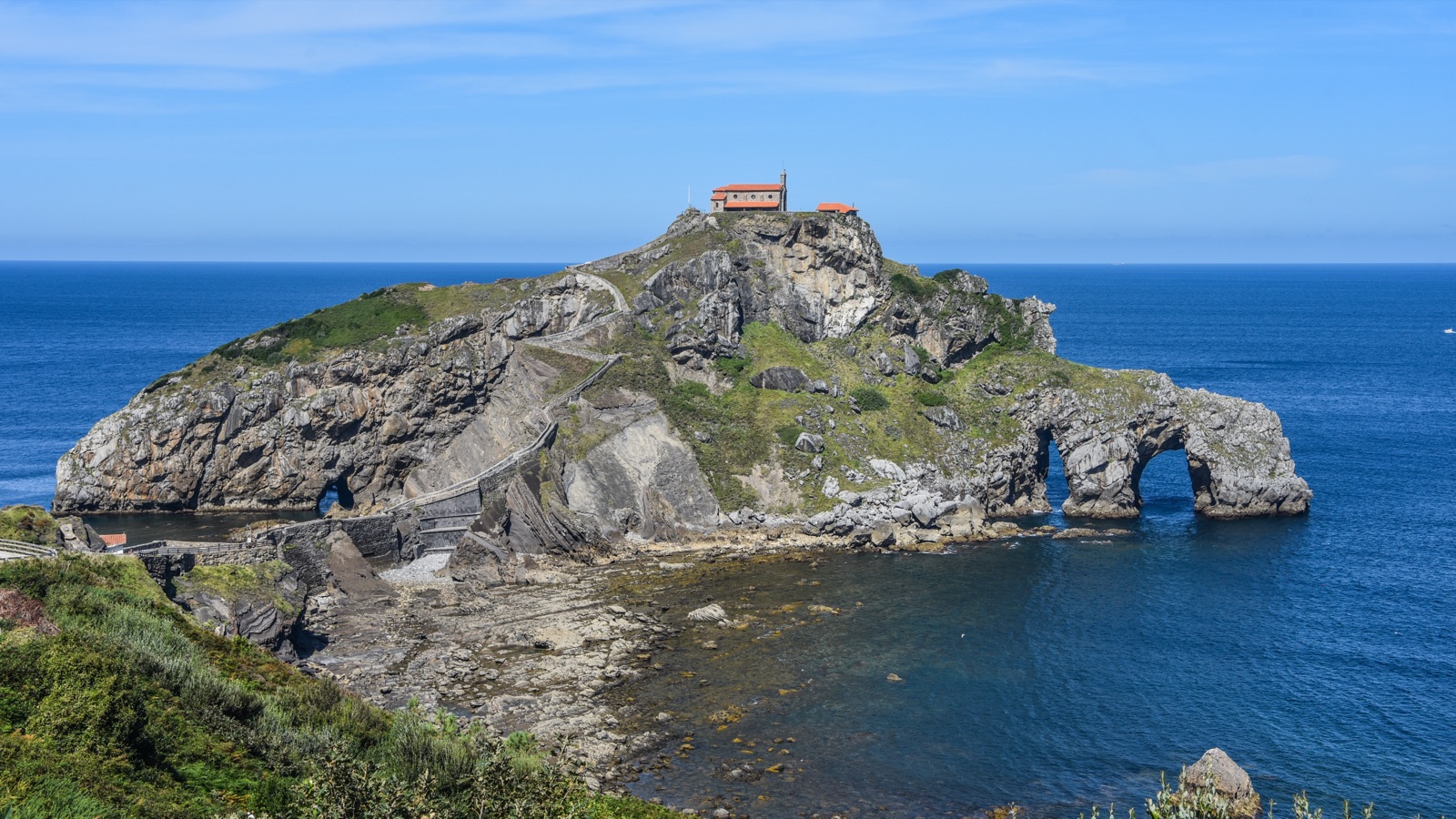
Gaztelugatxe Hermitage: History, Legends and Festival Days
The hermitage on top of San Juan de Gaztelugatxe is far older than it looks. The first church on the rock is believed to date from the 9th century; it became a convent in the 12th, a fortress in the wars of the 14th, a target for pirates in the 16th, and has burned and been rebuilt many times, most recently after a fire in 1978. It is still a living place of worship, tied to the fishermen of Bermeo and to the villages around it, with feast days when locals walk the path in their thousands. This guide tells that story and explains what it means for your visit: what you will see at the top, the traditions behind the bell and the footprint, and which days of the year belong to the locals.
The hermitage at a glance
- Dedication: St John the Baptist; Wikipedia names the small church after the Beheading of St John.
- Origins: the first hermitage is believed to date from the 9th century, becoming a convent in the 12th.
- Today’s building: not the original. Battles and fires have forced it to be rebuilt many times, and its last major rebuilding was completed in 1983.
- Municipality: San Juan de Gaztelugatxe belongs to Bermeo, although it is closer to Bakio, and for church purposes it belongs to the parish of San Pelayo in Bakio.
- Getting up: a stone bridge and a stairway of 241 steps link the islet to the coast.
- Mass days: 24 June, 31 July, 29 August and 30 December.
What the name means
The name tells you how people have always seen the rock. The provincial council says Gaztelugatxe may come from Gaztelu-aitz, “castle rock”. A document of 1053 calls the hermitage Sancti Johannis de Castiello, St John of the Castle, when Íñigo López, Lord of Bizkaia, and his wife Toda Ortiz gave it to the monastery of San Juan de la Peña. Whether or not there was ever a castle in the usual sense, the islet’s position made it a natural stronghold, and it was used as one.
A hermitage, then a convent
The first hermitage on the rock is believed to have been built in the 9th century, and it became a convent in the 12th century. Medieval burials of the 9th and 12th centuries have been found on the esplanade and inside the hermitage, so the site was clearly in use long before the stairway became famous.
The convent did not last. Basque Tourism says that two centuries after it became a convent, the friars left, taking every object of value with them.
You will sometimes read that the hermitage was founded by the Templars. Bizkaia’s tourism site repeats that tradition, but Wikipedia points out that it is impossible: the order was only founded in 1119, and earlier documents already record the church.
A fortress on the sea
The islet was not only a place of prayer. The provincial council says the hermitage also had a defensive purpose, protecting the power of the Lordship of Bizkaia. Its most famous moment came in 1334, when King Alfonso XI of Castile besieged Gaztelugatxe in pursuit of Juan Núñez de Lara, who held the rock with other Bizkaian knights. The defenders held out against the attacks for more than a month.
The royal chronicle of the time, quoted by the council, describes the rock as very strong, surrounded by the sea except for one narrow entrance, and records that the king could not take it while he was there. Standing on the bridge today, it is easy to see why: there is only one way up, and it is very narrow.
The siege left its mark on Bermeo too. In 1334, during the siege of Gaztelugatxe, Alfonso XI ordered Bermeo to be enclosed by a wall; the San Juan gate in that wall is where the old road to Gaztelugatxe began.
Pirates and fires
An isolated rock pounded by the sea was bound to attract raiders who imagined treasure inside. The provincial council says that at the end of the 16th century the English privateer Sir Francis Drake is said to have burned the hermitage, and that Huguenots from La Rochelle took Izaro and Gaztelugatxe, robbing everything they found and throwing the hermit off the cliff. Accounts differ on the details: Bizkaia’s tourism site dates Drake’s attack to 1596 and says his men killed the hermit.
The latest disaster is much closer to our own time. The council records that in 1978 the hermitage was set on fire and destroyed, and that its last major rebuilding was completed in 1983. What you see at the top today is that rebuilt church, on a site that has been rebuilt many times before.
The coast around it has its own war history. In the naval battle of 5 March 1937 off Cape Matxitxako, 35 sailors of the Basque Navy died fighting the rebel cruiser Canarias.
The fishermen’s saint
More than anything, San Juan de Gaztelugatxe belongs to the sea. Bizkaia’s tourism site describes the ex-votos inside: offerings from sailors saved from the sea, model ships left as offerings and paintings of boats about to be wrecked.
The fishing boats of Bermeo still honour the saint from the water. At the start of the bonito season, fishermen and neskatillas, the women who work at the port, go to Gaztelugatxe to ask for good health, good weather and a good catch. The ritual is also done at sea: boats round Gaztelugatxe three times to port and three times to starboard for luck, and the provincial council says the same happens when a new boat is launched.
The danger was real. Off nearby Cape Matxitxako, at midday on Holy Saturday 1878, a hurricane capsized 14 boats and 3 small craft, and 85 Bermeo sailors drowned. On the night of 12 to 13 August 1912, a galerna storm killed 116 people from Bermeo. Against that background, the model ships hanging in the hermitage are not decoration.
The bell and the footprint
Two traditions greet you at the top of the steps.
The bell. Tradition says you should ring the hermitage bell three times, for good luck and to ward off evil spirits. Expect a queue for it on busy days.
The footprint. Legend says St John the Baptist came from Bermeo to the hermitage in just three strides, and that he left four footprints: under the San Juan arch in Bermeo, by the Itsasalde farmhouse, on the Burgoa heights, and on the last step before the hermitage. The print on the last step is the one you can see, and the provincial council says it carries a chiselled “San Juan” inscription. Bermeo’s tourism site adds that whoever puts a foot in his print will not suffer from calluses for the rest of the year; Bizkaia’s tourism site says touching it brings good luck.
Other beliefs are attached to the place. The council says believers come to ask for help with headaches, leaving a txapela or a handkerchief, with sleep problems, or with fertility, leaving baby clothes at the foot of the image of St Anne.
The Virgin under the sea
Some of the hermitage’s story is underwater. In 1963 an image of the Virgin of Begoña, patron of Bizkaia, was placed on the seabed under one of the natural arches at the foot of the islet. Wikipedia says it lies at a depth of 10 metres, placed there at the initiative of divers. You cannot see it from the path, but there is a replica of the submerged Virgin in the church of San Francisco in Bermeo, and a floral offering is made to the image on 24 June.
Note that scuba diving is now prohibited in the Natural Monument, along with shellfish gathering.
The feast days of the year
Several fiestas include a visit to the hermitage from the surrounding villages, and each belongs to a different community.
| Date | Feast | Who comes |
|---|---|---|
| 24 June | St John the Baptist | A traditional romería, especially popular in Bermeo |
| 31 July | St Ignatius of Loyola | A romería from the village of Arrieta |
| 29 August | San Juan Degollado | A romería from Bakio; Bermeo’s council also comes |
| 30 December | Year-end mass | Local worshippers |
24 June is the big one. Bermeo’s tourism site says that on the Basque coast Gaztelugatxe is the place most visited by pilgrims, and that 24 June is the most important day. The provincial council describes crowds coming on pilgrimage to keep promises or simply to give thanks to the saint.
29 August has a civic side as well as a religious one. From about the 17th century the Bermeo town council went in procession to Gaztelugatxe, Izaro and Demiku to proclaim its jurisdiction, and the council still goes to Gaztelugatxe every year on 29 August. On the same date the romería comes from Bakio, which holds its San Juan Degollado fiestas at that time.
Mass is said in the hermitage on a few other days a year. The provincial council names two besides the feast of St John, 31 July and 30 December, while Bermeo’s tourism site also counts the day of the Bermeo town council’s procession and lists four mass days: 24 June, 31 July, 29 August and 30 December.
Should you visit on a feast day?
Probably not, unless you are there for the feast itself. The provincial council reserves 24 June, 31 July, 29 August, 31 August and 30 December for local socio-cultural celebrations and advises tourists not to visit on those days. The path is full of local families and pilgrims, and the hermitage is the centre of a community event rather than a sight.
If you happen to be on the coast on one of those days, enjoy the atmosphere in Bermeo or Bakio and come to Gaztelugatxe on another day. Our guide to the best time to visit has the rest of the calendar.
What you will see at the top
At the top of the 241 steps the islet opens out into a small esplanade around the church. Expect to find:
- The church itself, a simple building, rebuilt after the fire of 1978. Wikipedia says the small church stays closed most of the time, so on an ordinary day you may only see the outside; it opens for the feast-day masses.
- The bell on the front wall, rung three times for luck.
- The footprint on the last step.
- A small shelter beside the hermitage, which lets you get out of the wind.
- The view: the whole coast from Bakio to Cape Matxitxako, Akatx islet offshore and the Cantabrian Sea all round.
On the way up, notice the stations of a Way of the Cross that mark the path.
Respecting a living sanctuary
Gaztelugatxe is both a protected landscape and a place of worship. In the protected area camping, climbing, fires, noise, litter, diving, driving or parking outside marked places and flying drones are not allowed. Inside and around the church, behave as you would in any chapel: keep voices down, do not climb on the walls, and do not take or move offerings. If a service or a family gathering is under way, give it space.
Nature on the rock
The history is only part of what the provincial council protects. Because of its natural richness and fragility, Gaztelugatxe was declared a protected biotope in 1998 and renamed a Natural Monument in 2023, and in 2013 it joined the Natura 2000 network. Akatx islet, offshore, is a sanctuary for seabirds, including the storm petrel, which is very hard to see except in strong storms. Yellow-legged gulls, shags and peregrine falcons also stand out, and the cliffs of Cape Matxitxako hold Armeria euskadiensis, a plant found only on the Basque coast.
Learning more in Bermeo
If the history draws you in, spend an hour in Bermeo. The Gaztelugatxe Centre, which opened on 23 June 2026 in the old town, a few metres from the San Juan gate where the old road to Gaztelugatxe began, covers the Natural Monument’s nature, history and traditions. It opens on weekdays 10:00–15:00 and 16:00–18:00, and on Sundays and holidays 10:00–14:00, and is closed on Mondays and 9 September; Bermeo’s tourism site lists its season as 23 June to 30 September.
Nearby, look for the first of St John’s footprints under the San Juan arch, the only one of the seven gates of the old town wall still standing, and see the replica of the submerged Virgin in the church of San Francisco. Our Bermeo guide covers the town, and our day trips guide shows how to fit it into a day on the coast.
Visiting with the story in mind
To make the most of a visit:
- Come early or late, when you can stand on the bridge and picture the siege without a crowd behind you.
- Look for the stations of the cross as you climb, and the footprint on the last step.
- Use the audio guide. The provincial council offers one for the visit, and it adds context as you walk.
- Take a tour with time on the steps if you prefer a guide. The tours that include the hermitage leave you time to climb and ring the bell.
Our guide to access and the 241 steps covers tickets and the walk itself.
Frequently asked questions
How old is the Gaztelugatxe hermitage?
The first hermitage is believed to date from the 9th century, and a document of 1053 already records it. The present building is a reconstruction: its last major rebuilding was completed in 1983, after a fire in 1978.
Can you go inside the hermitage?
Not usually. The small church stays closed most of the time and opens for mass on its feast days: 24 June, 31 July, 29 August and 30 December.
Why do people ring the bell three times?
Tradition says ringing the hermitage bell three times brings good luck and wards off evil spirits.
Was Gaztelugatxe a castle?
Its name may mean “castle rock”, and the islet was used as a stronghold. In 1334 its defenders held out against King Alfonso XI of Castile for more than a month.
Did Francis Drake attack Gaztelugatxe?
The provincial council says he is said to have burned the hermitage at the end of the 16th century; Bizkaia’s tourism site dates the attack to 1596.
What happens on 24 June?
The feast of St John brings a romería and pilgrims from Bermeo and beyond, and a floral offering is made to the image of the Virgin on the seabed. Tourists are advised not to visit that day.