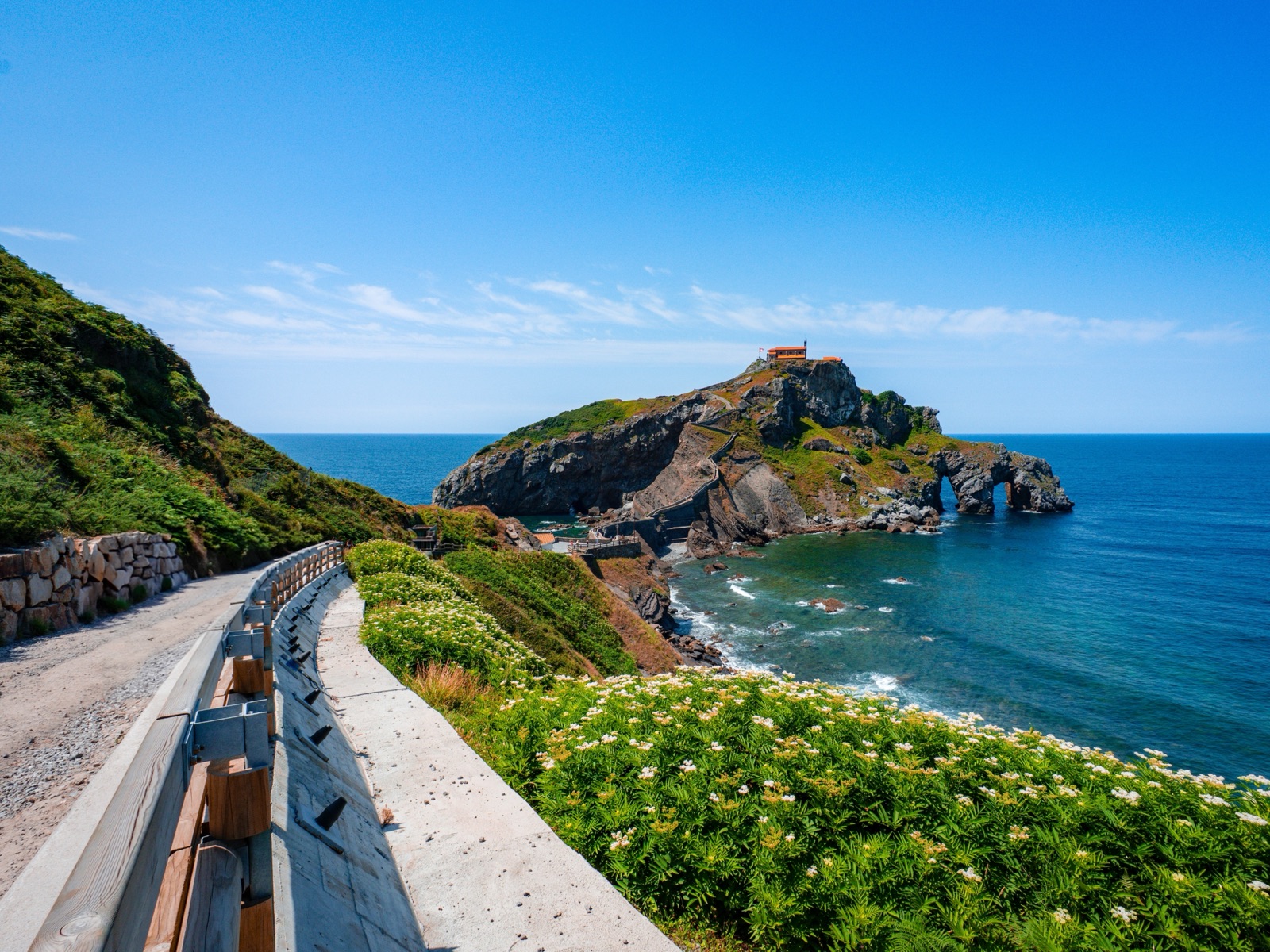
Best Time to Visit Gaztelugatxe: Seasons, Crowds and the Ticket Calendar
San Juan de Gaztelugatxe weather this week
San Juan de Gaztelugatxe hermitage
The five-day forecast for San Juan de Gaztelugatxe hermitage, updated through the day.
Forecast data from MET Norway (CC BY 4.0), summarised by day.
The best time to visit San Juan de Gaztelugatxe is spring or autumn, on a weekday, early in the morning or late in the afternoon. That is when the path is quietest, the light is kindest and you are least likely to need a ticket. Summer is the busiest season, midday is the busiest time of day, and a handful of local feast days are best left to the people of Bermeo, Bakio and Arrieta. This guide explains how the seasons, the free-ticket calendar, the crowds and the weather fit together, so you can choose your day with your eyes open.
The short answer
- Best seasons: spring and autumn. Bizkaia’s tourism site says the best time to visit is spring and autumn, since summer is usually more crowded, and Basque Tourism says that in autumn or spring the island is quiet.
- Best time of day: first thing in the morning or late in the afternoon. Midday is the busiest time, especially in summer and on public holidays.
- Busiest period: the summer, when access is controlled every day and you need a free ticket booked in advance. In 2026 that control ran without a break until Sunday 20 September.
- Days to avoid: 24 June, 31 July, 29 August, 31 August and 30 December, which the provincial council reserves for local celebrations.
- Always check: the weather forecast for the day, and whether your date needs a ticket.
How the ticket calendar shapes the year
Since 2018 the regional authorities have regulated the flow of visitors to protect what is now a Natural Monument, and the main tool is a free ticket. On days with controlled access you must book it online and show it to the staff at the access point; on other days access is free, with no booking or ticket. The system allows a maximum of 1,462 people a day.
Which days are controlled changes every year, and the provincial council publishes a calendar for each one. The pattern is predictable, though. Bermeo’s tourism site sums it up: a free ticket is compulsory in high season and on weekends, public holidays and long weekends in mid-season. Outside those periods, most days are free.
The 2026 calendar shows how this works in practice:
- Summer: access control ran without a break through the summer until Sunday 20 September.
- From 21 September: access became free again, though the calendar sets some controlled days in the following months.
- October: a ticket was needed on the 3rd, 4th, 10th, 11th, 12th, 17th, 18th, 24th, 25th and 31st, mainly weekends and the 12 October holiday.
- November: a ticket was needed only on 1 November.
- December: a ticket is needed on 5, 6, 7, 8 and 30 December; every other day to the end of the year is free access.
For a later year, look up the new calendar before you fix your date. Our guide to access and the 241 steps explains the booking itself in detail.
Gaztelugatxe through the year
The table below gives the general picture. Treat the ticket column as a pattern, not a promise, and check the calendar for your exact date.
| Season | Tickets | Crowds | What it is like |
|---|---|---|---|
| Winter | Mostly free access, except holiday weekends | Lightest | Short days, rougher sea, the most dramatic waves |
| Spring | Controlled at Easter and on many weekends | Moderate, busy at weekends | Green slopes, longer days, fine sunsets |
| Summer | Controlled every day | Heaviest | Warm, crowded at midday, car parks full |
| Autumn | Free on most weekdays, controlled on many weekends | Moderate | Quiet weekdays, softer light, more changeable weather |
Spring
Spring is the season most local sources recommend. Days lengthen, the hillsides above the cove turn green, and the path is far less crowded than in July and August. Bermeo’s tourism site singles out the spring sunsets at Gaztelugatxe as incredible, and notes that the path has small viewpoints along the way.
Easter is the exception. Holy Week and the weeks around it count as high season, the ticket system is in force and the coast fills with day-trippers. Weekends in spring are often controlled too. If you can, come on a weekday after Easter and before the summer rush.
Spring is also when the boats start. The scheduled boat route from Bermeo to Gaztelugatxe runs from March to October, and a second route past Izaro island to Elantxobe and Mundaka from April to October. Our boat trip guide covers both.
Summer
Summer is when Gaztelugatxe is at its busiest. Access is controlled every day, tickets for the popular time slots go early, and the provincial council warns that the car parks are usually full, especially between 10:00 and 16:00. If summer is the only time you can come, it is still worth it, but plan more carefully:
- Book your free ticket early, and aim for an early or late slot rather than the middle of the day.
- Leave the car in Bakio or Bermeo and take the bus, as the council recommends.
- Bring sun cream and water. In summer and on sunny days the council reminds visitors to bring sun cream to avoid sunburn, and the climb back up is hard work in the heat.
There are compensations. At Easter and in July and August, Bermeo runs buses with an accompanying tourist guide to Gaztelugatxe, and when you book that service you do not need to book the access ticket separately. In 2026 the guided bus was used 2,655 times in July and August. The new Gaztelugatxe Centre in Bermeo’s old town, which opened on 23 June 2026, is open in summer too, and also handles same-day tickets in person.
Summer is also the season for a swim. Basque Tourism says that in summer you will be tempted by a dip from the small pebble beaches at the foot of the stairway. The sea here is open and can be rough, so only swim when it is calm.
Autumn
Autumn may be the best compromise of all. After the summer control ends, many weekdays are free access, the crowds thin out and the light softens. In 2026, access became free from 21 September, and in October the ticket was needed mainly at weekends and on the 12 October holiday.
The weather becomes more changeable as the season goes on, and the sea grows livelier, which makes for spectacular photographs but a wetter walk. Cape Matxitxako, next to the islet, is an ideal place to watch cetaceans from summer to autumn, which adds a reason to stay longer on the coast. The boats keep running until the end of October.
Winter
Winter is the quietest time to visit. Most days need no ticket, the car parks have space and you may have long stretches of the path to yourself. The exceptions in 2026 were 1 November and the December holidays: 5, 6, 7 and 8 December, and 30 December, which is also a local feast day.
The trade-off is the weather. Days are short, the Cantabrian Sea can be wild, and the stone steps are slippery in rain. If you come in winter, watch the forecast closely, start early enough to be back up before dark and be ready to turn back if the wind or waves make the path unpleasant. The path itself is open all year.
The days to avoid
The provincial council reserves five days a year for local socio-cultural celebrations and advises tourists not to visit on them: 24 June, 31 July, 29 August, 31 August and 30 December. Most are linked to the hermitage’s own feasts:
- 24 June, the feast of St John, brings a traditional romería that is especially popular in Bermeo.
- 31 July, the feast of St Ignatius of Loyola, brings a romería from the village of Arrieta.
- 29 August, San Juan Degollado, brings a romería from Bakio, and Bermeo’s town council still goes to Gaztelugatxe every year on that date.
- 30 December has a year-end mass.
These are days for local people to gather at the hermitage, and the path is crowded with them. If your trip falls on one of these dates, visit another day. Our guide to the hermitage, its history and festivals explains what happens on each.
The best time of day
Whatever the season, the hour you arrive makes a big difference. Midday is the busiest time, especially in summer and on public holidays, and the council notes that the car parks fill most between 10:00 and 16:00. Bizkaia’s tourism site suggests coming first thing in the morning or late in the afternoon, when it is quieter and the evening light over the islet is at its best.
On ticketed days, choose your time slot with this in mind. Each ticket is for a set time; if you do not turn up, the booking is cancelled 60 minutes later. An early slot gets you down to the bridge before the crowds and back up before the heat of the day.
A late visit has its own appeal: softer light on the rock, the sun dropping towards the sea and the coach groups gone. Make sure you leave enough time to climb back up in daylight, and remember that the information points keep public hours of 10:00 to 19:00, when they hold a small first-aid kit.
Weather and the sea
Gaztelugatxe sits on an exposed stretch of the Cantabrian coast, and the weather can change quickly. The provincial council advises checking the forecast for the day of your visit. On days with an orange weather alert it recommends not climbing to the hermitage during the hours affected, and visitors with a booking who follow that advice are asked to cancel it online and book another day.
Our Gaztelugatxe weather page has a live forecast for the hermitage and month-by-month climate figures, so you can see how rain and sunshine vary through the year. A few practical points apply in any season:
- Rain makes the steps and the path slippery. Wear shoes with a good grip.
- Wind is stronger on the islet than in the car parks above, so bring a layer even on a fine day.
- Big seas are a spectacle from the path, but they cancel boat trips; the operator sends a cancellation message as early as possible in bad weather.
Weekdays or weekends?
If you have a choice, come on a weekday. Outside the summer and Easter, weekends and public holidays are the days most likely to be ticketed, and they are also the days when local families head for the coast. A Tuesday in May or a Wednesday in October can feel like a different place from a Saturday in August.
If you can only come at a weekend, book the free ticket as soon as the calendar shows it is needed, arrive early and consider the Ermu route, which is longer but gentler, for the way back.
Works on the path
The sea is constantly wearing away the rock under the path. In September 2026 the provincial council announced repairs to the walls that carry the path up to the hermitage, prioritising three stretches totalling 170 metres. The works were estimated to take four months, with an investment of close to €500,000, and have to be fitted around visitors, the weather and the tides. If you are visiting in the months that follow, check the council’s page for any notices before you go.
Booking tips for busy days
If your date needs a ticket, a few rules are worth knowing:
- Individuals can book up to ten tickets in a single booking. From 11 people, it must be made as a group booking.
- Bring the receipt. The emailed booking must be shown on paper or on a phone on arrival and kept during the visit.
- Cancel if your plans change. The council asks you to cancel so that others can visit, and not turning up without cancelling means you cannot make a new booking for a year.
Getting there in high season
Driving is the hardest part of a summer visit. The council recommends parking in Bakio or Bermeo and taking the bus. From Bilbao’s Termibus station, bus A3527 (Bilbao–Mungia–Bermeo) stops at San Juan de Gaztelugatxe, and Bermeo’s tourism site also advises leaving the car in Bermeo and using public transport. Motorhomes cannot use the Gaztelugatxe car parks at all, because of a height barrier.
Our guide to getting to Gaztelugatxe compares the bus, the car and the tours. On the busiest days a tour can take the pressure off: the tours that include time on the steps handle the transport and the timing for you.
How long to allow
Plan a good half day. The provincial council says the visit takes about two and a half hours. Gernika’s tourist office puts the walk down to the hermitage from Urizarreta at about 45 minutes, and Bermeo’s tourism site puts the walk itself at around 1 hour 30 minutes. The Urizarreta way in is steep, at 1,200 m with a 35% gradient, and the way back to Ermu is 1,600 m at 15%. In hot weather or crowds, allow longer.
There are toilets in only two places, by the information point at the Urizarreta entrance and by the Ermu control point, and picnic tables along the Ermu route. Build those into your timing.
Frequently asked questions
What is the best month to visit Gaztelugatxe?
Spring and autumn are the best seasons. Choose a weekday outside Easter, or a weekday in late September or October, when access is often free and the crowds are smaller.
Do I need a ticket in winter?
Usually not. In 2026 most winter days were free access, with tickets needed only on 1 November and on 5, 6, 7, 8 and 30 December. Check the calendar for your date.
What time of day is best?
Early morning or late afternoon. Midday is the busiest time, and the car parks fill most between 10:00 and 16:00.
Can I visit Gaztelugatxe on 24 June?
You can, but the provincial council advises tourists not to visit on 24 June, 31 July, 29 August, 31 August and 30 December, which are reserved for local celebrations.
Is Gaztelugatxe worth visiting in the rain?
It can be, if the weather is not severe. Wear shoes with a good grip and a waterproof. On orange-alert days, the council recommends not climbing to the hermitage during the hours affected.
Are the boat trips seasonal?
Yes. The scheduled boat route from Bermeo to Gaztelugatxe runs from March to October and lasts 1 hour.