Culture & film
Dragonstone Filming Location: Gaztelugatxe in Game of Thrones
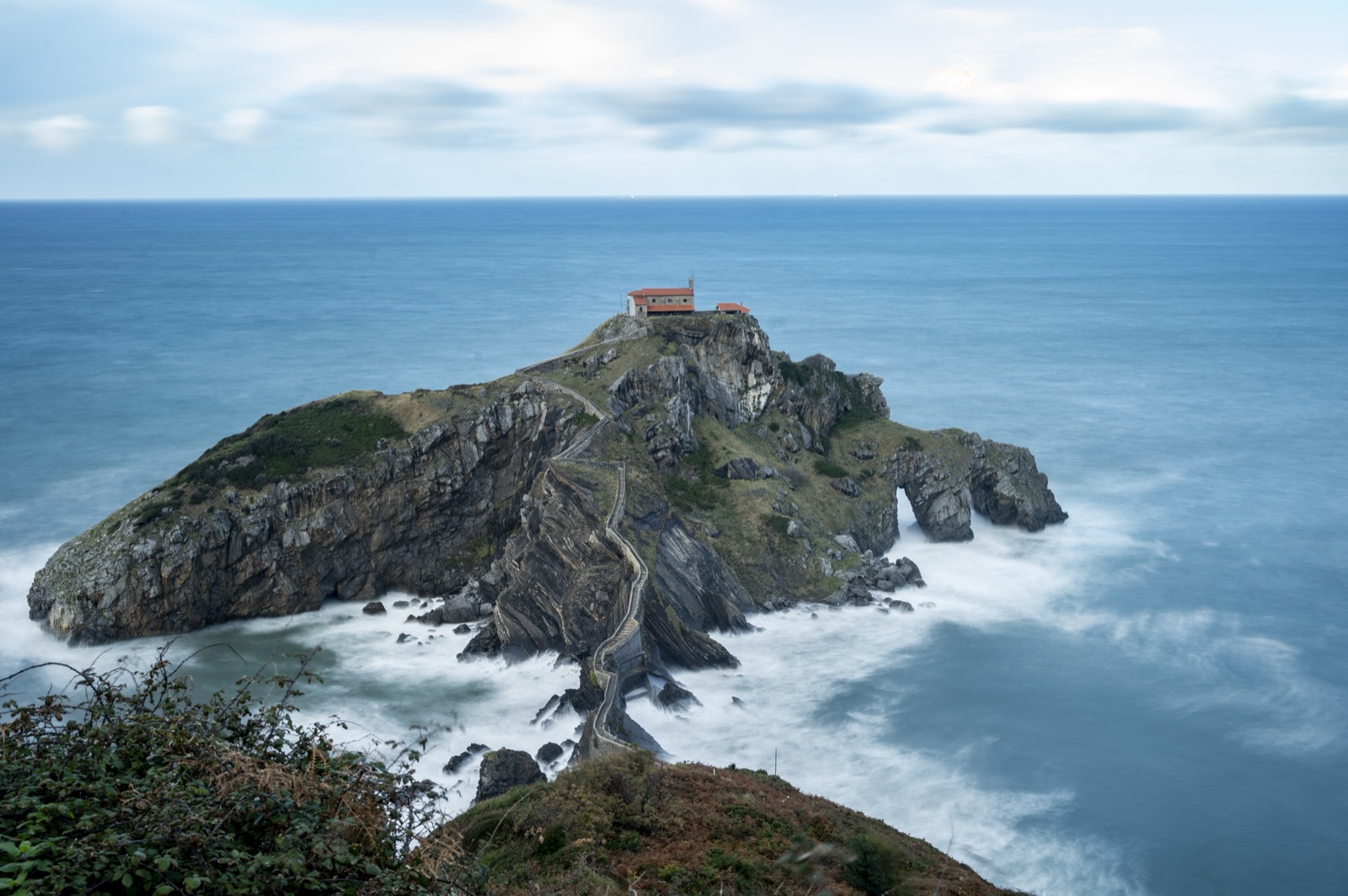
Dragonstone’s outdoor scenes in Game of Thrones were filmed on the Basque coast of northern Spain. The stone stairway that zigzags up to the castle is the real stairway of San Juan de Gaztelugatxe, a hermitage on a rocky islet in the municipality of Bermeo. The beaches that appear with it belong to two other places: Itzurun beach in Zumaia, where Basque Tourism says Daenerys’s landing was shot, and Muriola beach in Barrika. All three were filmed in 2016 for season 7.
What you will not find is the castle. The islet, the bridge and the steps are real; the fortress on top was added digitally in place of the small hermitage, and the interiors were sets built in Northern Ireland. This article sorts out what was real and what was not, where each scene was shot, how the series changed visits to Gaztelugatxe, and how to see the locations today.
The short answer
- Where: San Juan de Gaztelugatxe (the stairway and the islet), Itzurun beach in Zumaia and Muriola beach in Barrika, all on the Basque coast.
- When: filmed in 2016; season 7 was first broadcast from 16 July 2017 to 27 August 2017.
- What was real: the islet, the stone bridge, the 241 steps, the cliffs and the beaches.
- What was not: the castle, which replaced the hermitage digitally, and the throne room and other interiors, which were sets in Northern Ireland.
- Visiting today: access is free, but on controlled-access days you need a free ticket booked online, and the daily cap is 1,462 people.
Season 7 and the Basque shoot
In season 7, Dragonstone becomes Daenerys Targaryen’s base. It is the ancestral home of the Targaryens and her birthplace, and the episode that opens the season is named after it. In that first episode she returns home after spending her whole life in exile, and the scene rests on her silence and on the landscape; the study of the Basque locations calls Dragonstone the second main protagonist of the sequence.
Filming for the season began on 31 August 2016 at Titanic Studios in Belfast. The season was shorter than earlier ones, with seven episodes against ten, and the production moved through several Spanish locations, among them Seville, Cáceres, Almodóvar del Río, Santiponce, Zumaia and Bermeo.
The Basque part of the shoot came in the autumn of 2016. Muriola beach in Barrika had been announced as a new location for the seventh season, joining Bermeo and Zumaia, and the local press reported that the shoot meant the crews staying three months in Bilbao-Bizkaia. El País described the sequence as it happened: Barrika first, then San Juan de Gaztelugatxe, then Zumaia.
At Gaztelugatxe, a Europa Press report dated 20 October 2016 said the crew had occupied the site from that Thursday and that the public could not enter until the Sunday. Bermeo council had granted the production a special permit to occupy 30,500 square metres of public land, covering the location, the accesses and the perimeter, so that nothing about the new season leaked out. Basque Tourism’s own blog recalls that access was closed for a few days while the cameras and sets went in.
What was real and what was CGI
This is the question most visitors arrive with, and the answer is simple.
Real: the islet itself, the stone bridge from the mainland, the stairway climbing the spine of the islet, the cliffs on either side and the sea. The stairway to the castle in episode 3, “The Queen’s Justice”, is the real one, shown in its original form.
Not real: the castle. Basque Tourism says the islet was transformed into Dragonstone with digital effects. An academic study of the Basque locations, by Leyre Eguskiza-Sesumaga and Ignazio Gastaca-Egusquiza in the film journal L’Atalante, puts it plainly: the castle that takes the place of the hermitage in no way resembles the real spot. At the top of the steps there is a small hermitage, not a fortress.
Built elsewhere: the interiors. The same study notes that the indoor scenes were shot in Northern Ireland, and that Dragonstone on screen is the product of two completely different settings fused together with CGI and art direction. To tie them together, the designers added props shaped like the flysch rock formations of the Basque coast, including the walls of the royal hall and the throne itself.
Rearranged: the geography. The editing suggests that the beaches at Muriola and Itzurun lie at the foot of the same island. In reality the three spots are in different places, spread along the coast of two provinces.
So a visit gives you the islet, the bridge and the stairway exactly as they appear in the series, with a hermitage where the castle should be.
The locations, scene by scene
San Juan de Gaztelugatxe: the stairway
The zigzag stairway is the image everyone remembers. A stone bridge and a stairway of 241 steps link the islet to the coast between Bakio and Bermeo, and on screen they become the long climb to the castle gate. The study reproduces a still from episode 3 captioned “Stairway to the castle”, and it is that sequence fans come to retrace.
On the real islet the steps end at the hermitage of San Juan. The first hermitage is believed to date from the ninth century, and the present church has been rebuilt many times. Tradition says you ring its bell three times for good luck and to ward off evil spirits.
Itzurun beach, Zumaia: the landing
Basque Tourism says the scene of Daenerys landing at Dragonstone was filmed at Itzurun beach in Zumaia, in the province of Gipuzkoa. The study’s still from episode 1, “Dragonstone”, shows the beach and the sand, where Daenerys runs her hand over the ground and leaves her fingerprints.
Itzurun is backed by vertical limestone cliffs that drop up to 150 metres, the layered rock known as flysch, which Basque Tourism describes as having a history of more than 60 million years. The beach itself is 270 metres long, with strong waves.
Muriola beach, Barrika: the dragonglass
Muriola beach in Barrika appears in several scenes of the seventh season, according to Basque Tourism. The study links it with the dragonglass mine of the story, and points out a neat coincidence: Muriola is known locally as “the quarry beach”, because it is artificial, its sand coming from a nearby silica sand quarry.
It is a small beach, also known as La Cantera, about 10 minutes from the centre of Barrika, in an east-facing cove sheltered by cliffs, with views over the bay of Plentzia. It is also a nudist beach, which is worth knowing before you go.
Why this coast?
The study argues that the Basque coast was chosen for more than its looks. The flysch that defines this landscape does two jobs on screen. Like the rings of a tree, its stacked layers show the great age of the land, a fitting home for the oldest family in the story. And its horizontal ridges recall the crests along the backs of dragons, so that even without Daenerys the place seems to belong to them.
The authors see George R. R. Martin’s world taking shape on screen thanks to the choice of the Cantabrian coast as a setting. Whatever you make of that reading, it is true that the Basque locations do much of the storytelling in those scenes: the cliffs and the long climb say “ancient seat of power” before any CGI appears.
The other Spanish locations
Spain supplied far more than Dragonstone. Over the whole series, the study notes, cities such as Girona, Seville and Córdoba and landscapes such as the Bardenas Reales in Navarre stood in for settings including King’s Landing, Casterly Rock, Dorne and the Dothraki Sea. For season 7, the production also filmed in Seville, Cáceres, Almodóvar del Río and Santiponce. If you are following the series around Spain, the Basque coast is the northern end of a long trail.
How the series changed Gaztelugatxe
Gaztelugatxe was a much-loved place in Bizkaia long before HBO arrived. What changed was the scale.
- The summer of 2017: in the summer the season was released, around 280,000 people climbed the stairway, according to the study.
- 2019: the provincial council counted 727,995 visitors, 143,705 more than the year before.
- The ranking: a regional government report placed Gaztelugatxe as the second most popular destination in the Basque Country, behind only the Guggenheim Museum in Bilbao.
Promotion played its part. In mid-2017 the Basque Tourism Office created a website, Basque Country Is Coming, with film tours around the three settings, and the European Filming Commission Network named Gaztelugatxe the second best European location of the decade.
Not everyone was pleased. A local platform, SOS Gaztelugatxe, complained of more than 6,000 visits a day and called for an open debate on how the site was managed. The path and the steps are narrow and the islet is small, and on busy days more than 200 vehicles were counted parked on the road verges, where parking is banned.
From open access to booked tickets
The response came in stages, and it is the reason a visit now starts with a calendar check.
2018. The regional government approved measures to regulate the flow of visitors and preserve the protected biotope. They focused mainly on free tickets to visit at specific times, along with renovated walkways and more bus services.
2020. The provincial council went further. From 14 March, on the busiest days, access was capped at 3,024 people a day, with compulsory free online booking and no more than 340 people on the islet at once. The technical staff reached that figure by letting in 84 visitors every 15 minutes during the nine hours a day of access control, and by assuming the most common route: in via Urizarreta and out via Ermu. They estimated the round trip at 90, 105 or 120 minutes.
Today. On controlled-access days you still need a free ticket booked online, shown to staff at the access point, and the daily limit is lower than in 2020: 1,462 people. On other days access is free, with no booking or ticket. The calendar changes through the year, so check it for your date before you travel. Our guide to the access rules and the 241 steps explains how the booking works.
The protection has a legal basis too. Gaztelugatxe was declared a protected biotope in 1998 and was renamed a Natural Monument in 2023.
Visiting the three locations
Gaztelugatxe
This is the one to prioritise. There is a descent from the road, the bridge, the 241 steps and the whole way back, so allow time. The provincial council notes that the car parks by the road are usually full between 10:00 and 16:00 and recommends leaving the car in Bakio or Bermeo and taking the bus. There is no train to the islet, but Euskotren line E4 runs to Bermeo, and buses continue from there. Our guide to getting to Gaztelugatxe covers the buses, the car parks and the two walking routes.
Two practical points for fans. First, the provincial council reserves 24 June, 31 July, 29 August, 31 August and 30 December for local celebrations and asks tourists not to visit on those days. Second, the classic “Dragonstone” view, with the whole stairway snaking up the islet, is from the paths above the bridge. Take it on the way down, while you are fresh.
If you want the view from the sea, boats from Bermeo sail past Cape Matxitxako and Akatz rock to the islet and back. Hegaluze’s scheduled route runs from March to October and lasts 1 hour, and the operator cancels in bad weather, so treat it as a bonus rather than the plan.
Itzurun beach, Zumaia
Zumaia is in Gipuzkoa, well to the east of Gaztelugatxe along the coast, and deserves its own day or a stop between Bilbao and San Sebastián. The beach is close to the town centre, and the cliffs are the attraction: stand back from the base, look at the layers, and you will recognise the stage for Daenerys’s homecoming.
Muriola beach, Barrika
Barrika is on the Bizkaia coast west of Gaztelugatxe, overlooking the bay of Plentzia, and Muriola is about 10 minutes from the village centre. Basque Tourism calls it a less well-known corner, but just as spectacular.
Two or three days on the trail
Basque Tourism suggests spreading the locations over two or three days: Gaztelugatxe and Bermeo first, then Itzurun and Zumaia’s old town, then Barrika with a walk along its cliffs. It is a sensible order. Gaztelugatxe and Bermeo share a bus line and fit comfortably in a day; Zumaia is far enough away to deserve its own.
Bilbao makes a practical base. Basque Tourism notes that part of the crew and the cast stayed there during filming, with the Hotel Carlton as their base.
Tours with a Game of Thrones angle
Many day trips from Bilbao mention Dragonstone. What matters for a fan is time at the islet: a short stop may give you only the view from above, while a tour with free time lets you cross the bridge and climb the steps you saw on screen.
The tour from Bilbao with time for the steps allows two free hours at the islet before continuing to Bermeo and Gernika, in about 6 hours. The guided tour of Gaztelugatxe, Mundaka and Gernika from Bilbao starts at the hermitage and takes about 6 hours in an air-conditioned vehicle. On a controlled-access day, check whether the tour arranges your free ticket. The tours page compares the options.
Things fans often get wrong
- “The castle is on the island.” It is not. The top of the islet has a small hermitage; the castle was digital.
- “The beach is right below the stairway.” Also not. The landing beach is Itzurun in Zumaia and the dragonglass scenes are linked to Muriola in Barrika; editing made them look like one place.
- “You can just turn up.” On controlled-access days you cannot: the free ticket is compulsory and the daily cap is 1,462 people.
- “The throne room is inside.” The interiors were sets in Northern Ireland.
- “It is a quick stop.” The walk down, the steps and the climb back take real time and effort; the provincial council’s own estimate for the round trip was 90 to 120 minutes.
Frequently asked questions
Where was Dragonstone filmed?
The outdoor scenes of Dragonstone in season 7 were filmed on the Basque coast: the stairway and islet at San Juan de Gaztelugatxe, Itzurun beach in Zumaia and Muriola beach in Barrika. The interiors were shot on sets in Northern Ireland.
Is the Dragonstone castle real?
No. The islet, the bridge and the 241 steps are real, but the castle was added with digital effects in place of the small hermitage on top of the islet.
Which beach did Daenerys land on?
Basque Tourism says the scene of Daenerys landing at Dragonstone was filmed at Itzurun beach in Zumaia, known for its flysch cliffs up to 150 metres high.
When was Game of Thrones filmed at Gaztelugatxe?
In the autumn of 2016. A Europa Press report dated 20 October 2016 said the crew had occupied the site from that Thursday, with public access closed until the Sunday.
Do I need a ticket to climb the Dragonstone steps?
Only on controlled-access days, when you need a free ticket booked online and the daily cap is 1,462 people. On other days access is free with no booking, so check the calendar for your date.
Can I see all three Basque locations in one day?
It is possible by car but rushed, because Zumaia is a long way from the other two. Basque Tourism suggests two or three days, starting with Gaztelugatxe and Bermeo.